☠☠ WARNING! ☠
The stories mentioned on this site are of real deaths (famous or otherwise), and may contain graphic pics, text and/or videos. This site is NOT for the squeamish or Faint of Heart! You have been warned.
Strange as their stories may be, they were flesh and blood once, and were loved by people who knew them. Let's respect the deaths of those who have been mentioned....
 |
Yukio Mishima 三島 由紀夫
photograph by Shirou Aoyama (1956)
Pic Source |
Yukio Mishima (三島 由紀夫, Mishima Yukio) was the pen name of Kimitake Hiraoka (平岡 公威, Hiraoka Kimitake, January 14, 1925 – November 25, 1970), a Japanese author, poet, playwright, actor and film director, also remembered for his ritual suicide by seppuku after a failed coup d'état. Nominated three times for the Nobel Prize in Literature, Mishima was internationally famous and is considered one of the most important Japanese authors of the 20th century, whose avant-garde work displayed a blending of modern and traditional aesthetics that broke cultural boundaries, with a focus on sexuality, death, and political change.
Coup attempt and ritual suicide
On November 25, 1970, Mishima and four members of the Tatenokai, under pretext, visited the commandant of the Ichigaya Camp — the Tokyo headquarters of the Eastern Command of Japan's Self-Defense Forces. Inside, they barricaded the office and tied the commandant to his chair. With a prepared manifesto and banner listing their demands, Mishima stepped onto the balcony to address the soldiers gathered below. His speech was intended to inspire a coup d'état restoring the powers of the emperor. He succeeded only in irritating them, and was mocked and jeered. He finished his planned speech after a few minutes, returned to the commandant's office and committed seppuku. The customary kaishakunin duty at the end of this ritual had been assigned to Tatenokai member Masakatsu Morita, but Morita was unable properly to perform the task. After several failed attempts, he allowed another Tatenokai member, Hiroyasu Koga, to behead Mishima. Morita himself attempted to commit seppuku that day as well. When he failed, Koga once again performed the kaishakunin duty.
 |
Mishima delivering his speech in the
failed coup attempt just prior to
committing seppuku
(November 25, 1970) |
Another traditional element of the suicide ritual was the composition of jisei no ku (death poems) before their entry into the headquarters. Mishima planned his suicide meticulously for at least a year and no one outside the group of hand-picked Tatenokai members had any indication of what he was planning. His biographer, translator and former friend John Nathan suggests that the coup attempt was only a pretext for the ritual suicide of which Mishima had long dreamed. Mishima made sure his affairs were in order and left money for the legal defense of the three surviving Tatenokai members.
Much speculation has surrounded Mishima's suicide. At the time of his death he had just completed the final book in his Sea of Fertility tetralogy. He was recognized as one of the most important post-war stylists of the Japanese language. Mishima wrote 40 novels, 18 plays, 20 books of short stories, and at least 20 books of essays, one libretto, as well as one film. A large portion of this oeuvre comprises books written quickly for profit, but even if these are disregarded, a substantial body of work remains.
Seppuku
 Seppuku (切腹, "stomach-cutting") is a form of
Japanese ritual suicide by disembowelment. Seppuku was originally reserved only for samurai. Part of the samurai bushido honor code, seppuku was either used voluntarily by samurai to die with honor rather than fall into the hands of their enemies (and likely suffer torture), or as a form of capital punishment for samurai who had committed serious offenses, or performed for other reasons that had brought shame to them. The ceremonial disembowelment, which is usually part of a more elaborate ritual and performed in front of spectators, consists of plunging a short blade, traditionally a tantō, into the abdomen and moving the blade from left to right in a slicing motion.
Seppuku is also known as harakiri (腹切り, "cutting the belly"), a term more widely familiar outside Japan, and which is written with the same kanji as seppuku, but in reverse order with an okurigana.
Ritual
In time, carrying out seppuku came to involve a detailed ritual. This was usually performed in front of spectators if it was a planned seppuku, not one performed on a battlefield. A samurai was bathed, dressed in white robes, and fed his favorite meal. When he had finished, his instrument was placed on his plate. Dressed ceremonially, with his sword placed in front of him and sometimes seated on special cloths, the warrior would prepare for death by writing a death poem.
With his selected attendant (kaishakunin, his second) standing by, he would open his kimono (robe), take up his tantō (knife) or wakizashi (short sword)—which the samurai held by the blade with a portion of cloth wrapped around so that it would not cut his hand and cause him to lose his grip—and plunge it into his abdomen, making a left-to-right cut. The kaishakunin would then perform kaishaku, a cut in which the warrior was decapitated. The maneuver should be done in the manners of dakikubi (lit. "embraced head"), in which way a slight band of flesh is left attaching the head to the body, so that it be hung in front as if embraced. Because of the precision necessary for such a maneuver, the second was a skilled swordsman. The principal and the kaishakunin agreed in advance when the latter was to make his cut. Usually dakikubi would occur as soon as the dagger was plunged into the abdomen. The process became so highly ritualised that as soon as the samurai reached for his blade the kaishakunin would strike. Eventually even the blade became unnecessary and the samurai could reach for something symbolic like a fan and this would trigger the killing stroke from his second. The fan was likely used when the samurai was too old to use the blade, or in situations where it was too dangerous to give him a weapon in such circumstances.
Seppuku (切腹, "stomach-cutting") is a form of
Japanese ritual suicide by disembowelment. Seppuku was originally reserved only for samurai. Part of the samurai bushido honor code, seppuku was either used voluntarily by samurai to die with honor rather than fall into the hands of their enemies (and likely suffer torture), or as a form of capital punishment for samurai who had committed serious offenses, or performed for other reasons that had brought shame to them. The ceremonial disembowelment, which is usually part of a more elaborate ritual and performed in front of spectators, consists of plunging a short blade, traditionally a tantō, into the abdomen and moving the blade from left to right in a slicing motion.
Seppuku is also known as harakiri (腹切り, "cutting the belly"), a term more widely familiar outside Japan, and which is written with the same kanji as seppuku, but in reverse order with an okurigana.
Ritual
In time, carrying out seppuku came to involve a detailed ritual. This was usually performed in front of spectators if it was a planned seppuku, not one performed on a battlefield. A samurai was bathed, dressed in white robes, and fed his favorite meal. When he had finished, his instrument was placed on his plate. Dressed ceremonially, with his sword placed in front of him and sometimes seated on special cloths, the warrior would prepare for death by writing a death poem.
With his selected attendant (kaishakunin, his second) standing by, he would open his kimono (robe), take up his tantō (knife) or wakizashi (short sword)—which the samurai held by the blade with a portion of cloth wrapped around so that it would not cut his hand and cause him to lose his grip—and plunge it into his abdomen, making a left-to-right cut. The kaishakunin would then perform kaishaku, a cut in which the warrior was decapitated. The maneuver should be done in the manners of dakikubi (lit. "embraced head"), in which way a slight band of flesh is left attaching the head to the body, so that it be hung in front as if embraced. Because of the precision necessary for such a maneuver, the second was a skilled swordsman. The principal and the kaishakunin agreed in advance when the latter was to make his cut. Usually dakikubi would occur as soon as the dagger was plunged into the abdomen. The process became so highly ritualised that as soon as the samurai reached for his blade the kaishakunin would strike. Eventually even the blade became unnecessary and the samurai could reach for something symbolic like a fan and this would trigger the killing stroke from his second. The fan was likely used when the samurai was too old to use the blade, or in situations where it was too dangerous to give him a weapon in such circumstances.
This elaborate ritual evolved after seppuku had ceased being mainly a battlefield or wartime practice and become a para-judicial institution.
The second was usually, but not always, a friend. If a defeated warrior had fought honorably and well, an opponent who wanted to salute his bravery would volunteer to act as his second.
Did You Know?
The first recorded time a European saw formal seppuku was the "Sakai Incident" of 1868. On February 15, eleven French sailors of the Dupleix entered a Japanese town called Sakai without official permission. Their presence caused panic among the residents. Security forces were dispatched to turn the sailors back to their ship, but a fight broke out and the sailors were shot dead. Upon the protest of the French representative, financial compensation was paid and those responsible were sentenced to death. The French captain was present to observe the execution. As each samurai committed ritual disembowelment, the violent act shocked the captain, and he requested a pardon, due to which nine of the samurai were spared. This incident was dramatised in a famous short story, Sakai Jiken, by Mori Ōgai.
Source |
Source
 |
八代目 明治39年(1906) ~昭和50年(1975) 俳名 是真
Pic source |
Bandō Mitsugorō VIII (八代目 坂東 三津五郎, Hachidaime Bandō Mitsugorō), (19 October 1906–16 January 1975) was one of Japan's most revered Kabuki actors from the 1930s until his death. He was a renowned tachiyaku and katakiyaku, specializing in particular in the aragoto style. He was officially designated as a "living national treasure" by the Japanese government in 1973.
Eighth in the line of Bandō Mitsugorō, he was adopted by Bandō Mitsugorō VII; his son and grandson would go on to take the name as well, becoming ninth and tenth in the line respectively.
He later tried to adapt The Tale of Genji to the stage, but was prohibited from doing so by the authorities.
After a few years in a kabuki troupe run by the Toho company, he moved to Kansai; he lived there for nearly 20 years, performing in Osaka and other venues, and taking part in the final performances at the Ōsaka Kabuki-za, which closed and became a department store in 1958.
In 1962, following his return to Tokyo, and the death of his adopted father Bandō Mitsugorō VII, Bandō celebrated a shūmei (naming ceremony) alongside his son, Bandō Mitsugorō IX and grandson Bandō Mitsugorō X. He took the name Mitsugorō VIII. Four years later, he performed at the opening ceremonies for Tokyo's National Theater.
He performed as Kakogawa Honzō in Kanadehon Chūshingura (the Tale of the 47 Ronin) in December 1974, at the National Theater. This was among his final performances, as he died the following month at age 68.
Death
He visited a Kyoto restaurant with friends and ordered an illegally large helping of four livers of the fugu fish. The fugu chef of the restaurant could not refuse the request from such a prestigious artist.
Claiming that he could survive their poisons, he ate the livers and died after seven hours of paralysis and convulsions.
Subsequently, the chef lost his license for breaking the law.
Fugu Facts
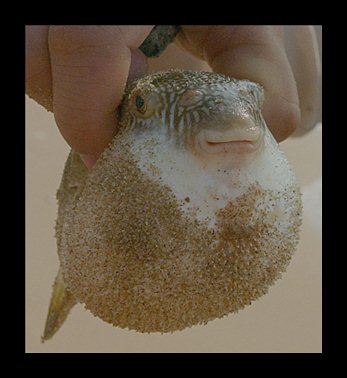
Fugu (河豚 or 鰒; フグ?, literally "river pig") is the Japanese word for pufferfish and the dish prepared from it.
Fugu can be lethally poisonous due to its tetrodotoxin; therefore, it must be carefully prepared to remove toxic parts and to avoid contaminating the meat. The restaurant preparation of fugu is strictly controlled by the law in Japan and several other countries, and only chefs who have qualified through rigorous training are allowed to deal with the fish. However, the domestic preparation occasionally leads to accidental death. Fugu is served as sashimi and chirinabe. Some consider the liver the tastiest part but it is also the most poisonous, and serving the fugu liver in restaurants was banned in Japan in 1984. Fugu has become one of the most celebrated and notorious dishes in Japanese cuisine.
Fugu contains lethal amounts of the poison tetrodotoxin in the organs, especially the liver, the ovaries, and the skin. The poison, a sodium channel blocker, paralyzes the muscles while the victim stays fully conscious along with causing paralysis. The victim is unable to breathe, and eventually dies from asphyxiation. There is no known antidote. The standard treatment is to support the respiratory and circulatory systems until the poison is metabolised and excreted by the victim's body.
Advances in research and aquaculture have allowed some farmers to mass-produce safe fugu. Researchers surmised that fugu's tetrodotoxin came from eating other animals that held tetrodotoxin-laden bacteria and developed immunity over time. Many farmers now produce 'poison-free' fugu by keeping the fugu away from the bacteria. Usuki, a town in Ōita Prefecture, has become known for selling non-poisonous fugu.
Source | Source | Source
Kenji Urada (c. 1944 — July 4, 1981) was one of the first persons reported to have been killed by a robot.
On July 4, 1981, Urada was employed as a 37-year old maintenance engineer at a Kawasaki Heavy Industries plant. While working on a broken robot, he failed to turn it off completely, resulting in the robot pushing him into a grinding machine with its hydraulic arm. He died as a result. The circumstances of his death were not made public until December 8, after an investigation by the labor standards bureau was completed.
It was the first recorded fatality blamed on one of the about 70,000 robots in use in Japanese industrial plants.
The investigators said Kenji Urada stepped across a safety barrier and inadvertently started the robot, whose arm stabbed him in the back.
Urada apparently hit the on-switch accidentally after leaping over a chain fence built around the robot that was labelled "Off Limits," officials said.
Source
A young, shy Japanese couple that had been married for fourteen years were too repressed to even consummate their marriage by making love.
Eventually, one day, after a bottle of plum wine, they tried again, and at which time they succeeded.
However, unfortunately for them, their hearts were not physically ready for such a shock, and they both died from cardiac arrest after achieving simultaneous orgasms.
This true story of strange death(s) was based on the deaths of Sachi and Tomio Hidaka from Tokyo, Japan. Not much else seems to be known about this story.